OncoFirm™-L
Investigational Rapid Lateral Flow Assay for Thomsen–Friedenreich (TF) Glycoantigen Investigational device. OncoFirm™-L is in development and has not been cleared or approved by the U.S. Food and Drug Administration [or…
Investigational Rapid Lateral Flow Assay for Thomsen–Friedenreich (TF) Glycoantigen
Investigational device. OncoFirm™-L is in development and has not been cleared or approved by the U.S. Food and Drug Administration [or any other regulatory authority — confirm; see Regulatory Status]. It is not available for sale. For Investigational Use Only. The performance characteristics of this product have not been established. No clinical claims are made for this product.
Overview
OncoFirm™-L is a single-use lateral flow immunoassay under development by OncoFirm Diagnostics for the detection of the Thomsen–Friedenreich (TF) glycoantigen (Galβ1-3GalNAc; CD176) in human [serum, plasma, and whole blood]. The TF antigen is a carbohydrate structure that is normally masked on healthy cells and becomes exposed on the surface of many carcinomas. It has been studied in tumor tissue for decades; measuring it in blood is a newer and still early area of research.
OncoFirm Diagnostics is investigating whether a rapid, low-cost assay for circulating TF antigen could one day contribute to the evaluation of patients at elevated risk of lung and other cancers. That question is unanswered. Whether OncoFirm™-L has any clinical role, in which patients, and in which care settings will be determined by the outcome of analytical and clinical studies and by regulatory review. Nothing on this page should be read as a claim that the assay detects lung cancer.
Development Stage and Research Objective
This section replaces an intended-use statement. An intended use will be proposed only when validation data support one.
- Analytical objective: To establish that OncoFirm™-L detects TF glycoantigen in [specimen type(s)] with acceptable sensitivity, specificity, precision, and freedom from interference at a defined cutoff.
- Clinical research question: To evaluate whether circulating TF antigen levels, as measured by this assay, are associated with the presence of lung cancer in [a defined study population], and whether any such association is strong enough and specific enough to be clinically useful alongside existing methods of evaluation.
- What the assay is not being developed to do: OncoFirm™-L is not being developed as a substitute for low-dose CT screening in individuals who are eligible for it, and it is not intended to defer, replace, or reduce the use of imaging.
Product Design
Design specifications. Performance has not been established.
- Analyte: Thomsen–Friedenreich glycoantigen (Galβ1-3GalNAc) [specify the form measured — e.g., TF antigen carried on circulating glycoproteins or extracellular vesicles — and the capture/detection reagents used]
- Specimen types: [Serum, plasma, whole blood — each to be confirmed in analytical validation]
- Format: Single-use lateral flow immunoassay cassette
- Time to result: Approximately 15 minutes (design target)
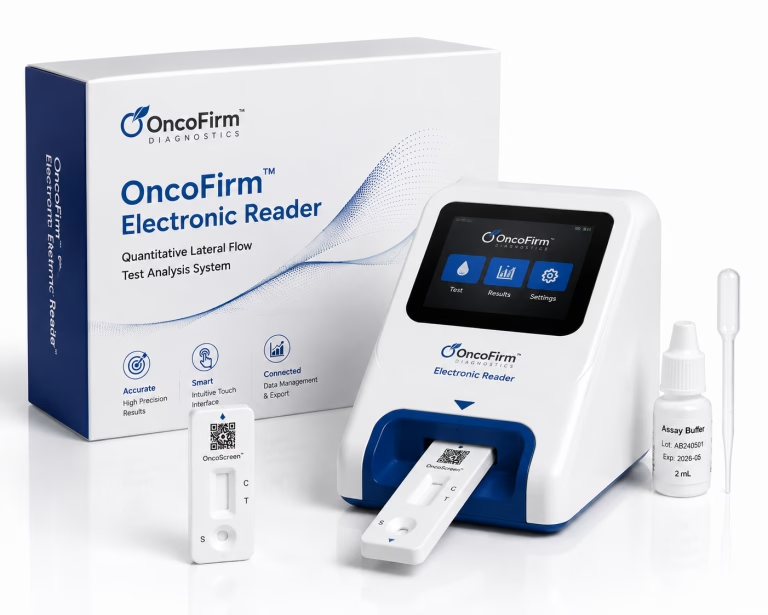
- Readout: [Visual qualitative result relative to a predefined cutoff | Fluorescent signal read with the OncoFirm™ reader (in development)]
- Cutoff: [Under evaluation]
- Digital components: [Reader and companion software are in development and will be evaluated as part of the regulated test system]
- Storage and shelf life: [To be established in stability studies]
About the TF Glycoantigen
- The TF antigen (Galβ1-3GalNAcα-O-Ser/Thr, also called CD176 or the T antigen) is a disaccharide structure on cell-surface glycoproteins. On healthy cells it is usually hidden by sialic acid; on many carcinomas it is exposed. It has been reported on the majority of breast, colon, lung, prostate, ovarian, gastric, and bladder carcinomas, and has been studied as a marker of malignancy and metastatic potential.
- Because it is expressed across many carcinoma types, the TF antigen is not specific to lung cancer. A TF antigen result cannot by itself indicate the organ of origin of a cancer.
- Most published work on TF antigen uses tumor tissue. Measuring TF antigen in blood is at an early research stage. Recent small, retrospective case-control studies have reported that TF antigen carried on circulating extracellular vesicles can discriminate lung and breast cancer patients from healthy controls, and later work has reported similar findings across several cancer types. These findings have not been validated in prospective studies in screening or symptomatic populations, and they were generated with laboratory instruments, not with a lateral flow test.
- The extent to which smoking, chronic respiratory disease, infection, or inflammation affects circulating TF antigen has not been characterized.
- [No TF-antigen-based blood test is currently cleared or approved by the U.S. FDA for any cancer detection purpose — confirm.]
- The established screening test for lung cancer is annual low-dose CT (LDCT) in adults at high risk because of smoking history (in the U.S., ages 50–80 with at least a 20 pack-year history, per USPSTF). Blood biomarker measurement is not a recommended lung cancer screening method under current U.S. guidelines.
Limitations
- Performance characteristics of OncoFirm™-L, including sensitivity, specificity, precision, and interference, have not been established. No clinical performance claims are made.
- OncoFirm™-L is not a lung cancer screening test and is not a substitute for low-dose CT in individuals who are eligible for LDCT screening. It is not intended to defer, replace, or reduce imaging.
- A result cannot localize a cancer to the lung. TF antigen is expressed by many carcinoma types and may be present in some non-malignant conditions.
- The assay is not intended for the evaluation or follow-up of lung nodules, for surveillance after treatment, or for use alongside LDCT in surveillance programs. None of these uses has been studied.
- A result below the cutoff does not exclude cancer; a result above the cutoff does not establish it.
- Not for self-testing or home use.
Development Program
Include only what is factually current. If a clinical study is ongoing, be prepared to identify its registration.
OncoFirm Diagnostics is conducting [analytical] [and clinical feasibility] studies of OncoFirm™-L [in collaboration with (institutions)] [registered as (registry and identifier)]. Findings will be [published | submitted to regulatory authorities] as they become available. Healthcare professionals and institutions interested in research collaboration may contact [email].
Regulatory Status
- United States: OncoFirm™-L has not been cleared or approved by the U.S. FDA and is not available for sale in the United States. Any U.S. use is limited to investigational use. OncoFirm Diagnostics [intends to seek FDA feedback on a development plan | is preparing a premarket submission]. The timing and outcome of any regulatory review cannot be assured.
- European Union and other markets: [Choose one, and only if true. (a) “OncoFirm™-L is a product in development and has not been CE marked or authorized for sale in any market.” (b) “OncoFirm™-L is CE marked under the In Vitro Diagnostic Medical Devices Regulation (EU) 2017/746, Class C, notified body certificate no. ____, and is available in (countries) through authorized distributors.” Do not publish a CE claim that cannot be supported by a declaration of conformity and, under IVDR, a notified body certificate.]
- Product images on this page are concept renderings, illustrative of intended functionality.
Contact
[Contact details for research institutions, laboratories, and potential clinical collaborators. Note: inquiries are limited to research and investigational use.]