Optical / Systems Engineer – Digital Cancer Diagnostics
Optical / Systems Engineer – Digital Cancer Diagnostics OncoFirm™ Diagnostics Corporation Lateral Flow Electronic Reader (LFER) Technology | AI-Assisted Diagnostics Long Island, New York OncoFirm™ Diagnostics Corporation is seeking an…
Optical / Systems Engineer – Digital Cancer Diagnostics
OncoFirm™ Diagnostics Corporation
Lateral Flow Electronic Reader (LFER) Technology | AI-Assisted Diagnostics
Long Island, New York
OncoFirm™ Diagnostics Corporation is seeking an innovative Optical / Systems Engineer to support the development of our next-generation Lateral Flow Electronic Reader (LFER) platform for digital cancer diagnostics.
This position will play a key role in designing and integrating the optical, electronic, mechanical, embedded software, and AI-assisted components of a portable electronic cassette reader intended to quantitatively analyze fluorescent lateral flow assays and cancer-associated biomarker signals.
The ideal candidate combines hands-on optical instrumentation experience with systems engineering, embedded electronics, digital imaging, signal processing, and software development.
Position Responsibilities
The Optical / Systems Engineer will contribute to the complete reader-development lifecycle, including:
- Design and development of optical systems for fluorescent lateral flow assay detection.
- Selection and integration of LEDs, laser diodes or other excitation sources, optical filters, lenses, photodiodes, CMOS/CCD sensors, and related detection components.
- Development of optical configurations capable of accurately detecting and quantifying fluorescence from lateral flow test cassettes.
- Design of the cassette positioning, alignment, illumination, scanning, and detection architecture.
- Optimization of excitation and emission paths to improve signal-to-noise ratio, sensitivity, repeatability, and dynamic range.
- Integration of optical, mechanical, electrical, firmware, and software subsystems into the OncoFirm Electronic Reader.
- Development and evaluation of reader calibration procedures and reference standards.
- Design of methods for compensating for environmental variation, assay-lot variation, optical drift, background fluorescence, and cassette-to-cassette variability.
- Development of algorithms for test-line detection, control-line verification, fluorescence quantification, image processing, and signal analysis.
- Collaboration on AI-assisted interpretation of lateral flow assay results.
- Support development of software capable of converting raw optical measurements into quantitative diagnostic information.
- Integration of embedded processors, sensors, displays, communications systems, and electronic control systems.
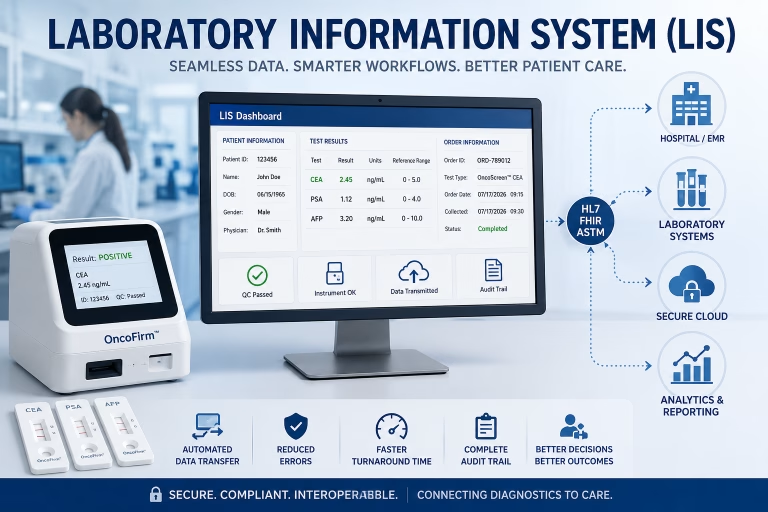
- Support development of Bluetooth, Wi-Fi, USB, cloud, LIS, EMR/EHR, or other connectivity functions as appropriate.
- Establish system specifications, design requirements, test protocols, verification procedures, and engineering documentation.
- Develop and test prototypes from proof-of-concept through design verification.
- Perform root-cause analysis and troubleshooting of optical, electronic, mechanical, firmware, and software performance issues.
- Work closely with assay scientists to optimize the relationship between fluorescent chemistry, lateral flow strip design, cassette geometry, and reader performance.
- Collaborate with external engineering, manufacturing, research, and development partners.
AI & Software Engineering
The successful candidate should be comfortable working at the intersection of physical instrumentation and intelligent software.
Relevant responsibilities may include:
- Computer vision and digital image analysis
- Fluorescence signal processing
- Automated test-line and control-line recognition
- Background correction and normalization
- Quantitative curve fitting
- Calibration algorithms
- Pattern recognition
- Machine-learning-assisted signal interpretation
- Confidence scoring and quality-control algorithms
- Detection of abnormal assay or reader conditions
- Software integration between reader hardware and cloud-based analytical systems
- Development of structured datasets for future AI model development
Experience with Python, C/C++, MATLAB, OpenCV, TensorFlow, PyTorch, embedded systems, or equivalent engineering environments is highly desirable.
Preferred Technical Background
Candidates may have experience in one or more of the following areas:
- Optical engineering
- Biomedical engineering
- Electrical engineering
- Systems engineering
- Imaging systems
- Medical device instrumentation
- Fluorescence detection
- Spectroscopy
- Biosensors
- Lateral flow assay readers
- Point-of-care diagnostic instrumentation
- Digital pathology or medical imaging
- Embedded electronics
- Computer vision
- Signal processing
- Artificial intelligence / machine learning
- Instrument control software
Preferred Qualifications
Bachelor’s, Master’s, or Ph.D. in Optical Engineering, Electrical Engineering, Biomedical Engineering, Systems Engineering, Physics, Computer Engineering, or a related discipline.
Preferred experience includes:
- Optical instrumentation or fluorescence detection systems
- Medical-device or diagnostic-device development
- Prototype development and system integration
- Imaging sensors, photodiodes, CMOS/CCD systems, or fluorescence detectors
- Optical filter and illumination-system design
- Embedded processors and microcontrollers
- Hardware/software integration
- Signal-processing algorithms
- AI or machine-learning applications
- Design verification and validation
- Design controls and engineering documentation
Experience with lateral flow readers, immunoassay instrumentation, fluorescence diagnostics, biosensors, or point-of-care medical devices is especially valuable.
About the Technology
OncoFirm is developing a digital diagnostic platform combining:
Fluorescent Lateral Flow Assays → Electronic Cassette Reader → Digital Signal Analysis → AI-Assisted Interpretation → Connected Diagnostic Data
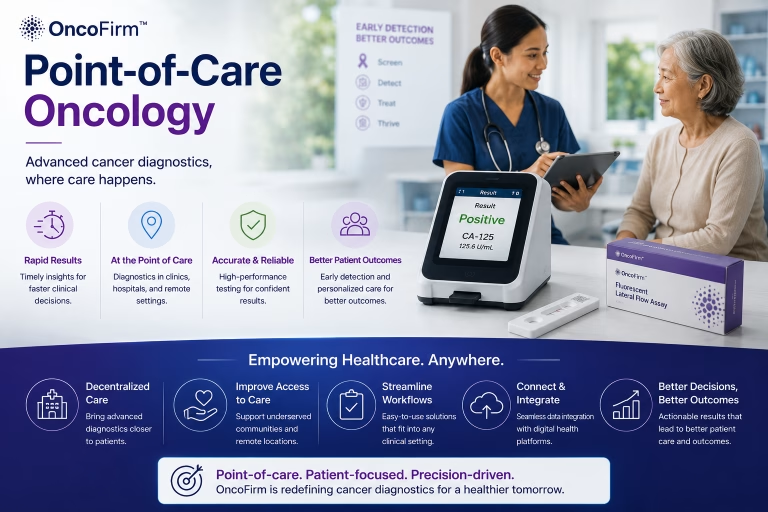
The OncoFirm Lateral Flow Electronic Reader is being developed to objectively capture and analyze fluorescent assay signals rather than relying solely on visual interpretation.
Our broader objective is to develop portable, connected diagnostic technologies capable of supporting cancer biomarker research and future clinical diagnostic applications.
The Opportunity
This is an opportunity to help engineer a diagnostic instrument from an early development stage through prototype refinement, system integration, validation, and eventual commercialization.
The engineer will have an opportunity to influence:
Optics • Electronics • Reader Architecture • Cassette Design • Firmware • AI • Signal Processing • Connectivity • Prototype Development • Manufacturing
We are particularly interested in engineers who enjoy solving multidisciplinary problems and want to participate directly in building a new diagnostic technology platform.
Company
OncoFirm™ Diagnostics Corporation
Digital Cancer Diagnostics Solutions
Fluorescent Lateral Flow Technology
AI-Assisted Diagnostic Systems
Website: www.oncofirm.com
Location: Long Island, New York
Qualified engineers, researchers, consultants, and experienced medical-device developers interested in collaborating with OncoFirm are encouraged to apply.